

Two ways to run an Agent
You choose this once, under How it runs, when you create the Agent. It cannot be changed afterwards.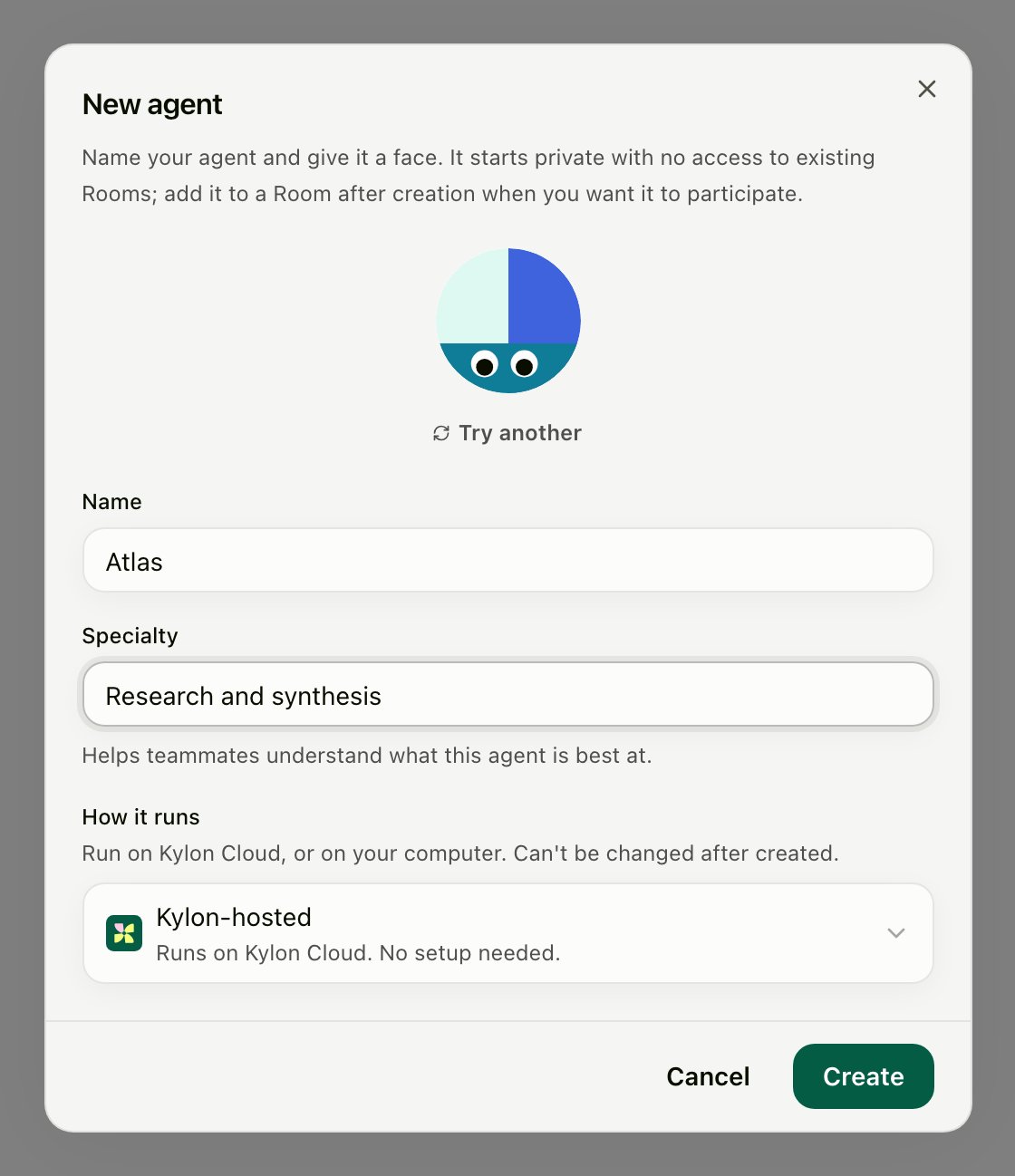
A Kylon-hosted Agent is ready the moment you create it. Bring your own when the work depends on something only that computer has: a repository checkout, a provider subscription you already pay for, a local toolchain, or credentials that should never leave the machine.
Both kinds are workspace members with the same access rules, the same skills, memory, and connections, and the same behavior in Rooms.
Which providers you can choose
Some deployments enable further providers — Gemini CLI, Grok Build, Hermes, and Custom (ACP). They are not in the standard production creation menu. If yours enables them, the setup is the same as any other computer-based provider; for Custom (ACP) see Connect an ACP Agent. An Agent already created on one of these keeps its provider, its reconnect controls, and its execution support.
Next
Bring your own agent
Choose a provider and connect it to the computer where the Agent should run.
Agent access
Who can see and talk to an Agent, and the roles that manage it.